On the Road Again
The SCFD has been approved by voters four times over the course of our 35-year history of providing culture for all. Time flies when you’re providing foundational support to hundreds of arts, culture and science organizations loved by millions and the SCFD is gearing up to ask voters to continue their support in 2028. Denver metro area voters created the district in 1987 and for three decades the SCFD has asked them to keep a good thing going for arts and culture in our region. Every single time voters have replied with a resounding “yes.”
In 2025, the SCFD Board of Directors approved a framework for collecting the input the district will need from stakeholders and supporters to chart a vision for the district’s future. Over the next few years, in partnership with GBSM, we will be conducting research and engaging with SCFD stakeholders to gather feedback and build consensus on the right framework to carry the district into its next era.
Funded Partners: Submit Nominations for the Reauthorization Input Committee!
The SCFD Reauthorization Input Committee will be comprised of a diverse range of community voices reflective of the seven-county district. This group will advise and inform the SCFD’s potential paths forward as it pursues reauthorization. The committee members will utilize their expertise, perspectives and connections to inform the Road to Reauthorization process for phases 3 and 4, ensuring that it is reflective of the community the SCFD serves.
Funded organizations will have the opportunity to nominate Reauthorization Input Committee participants. Ideal candidates will have depth and breadth of operational application and experience with SCFD structure and processes. They will represent a diverse range of funded organizations and are committed to the long-term success of the SCFD. Committee members will be required to attend meetings between November 2026 – September 2027, with some additional time required for input coordination each month during that period. More details will be shared with potential members as the committee is established.
The Timeline:
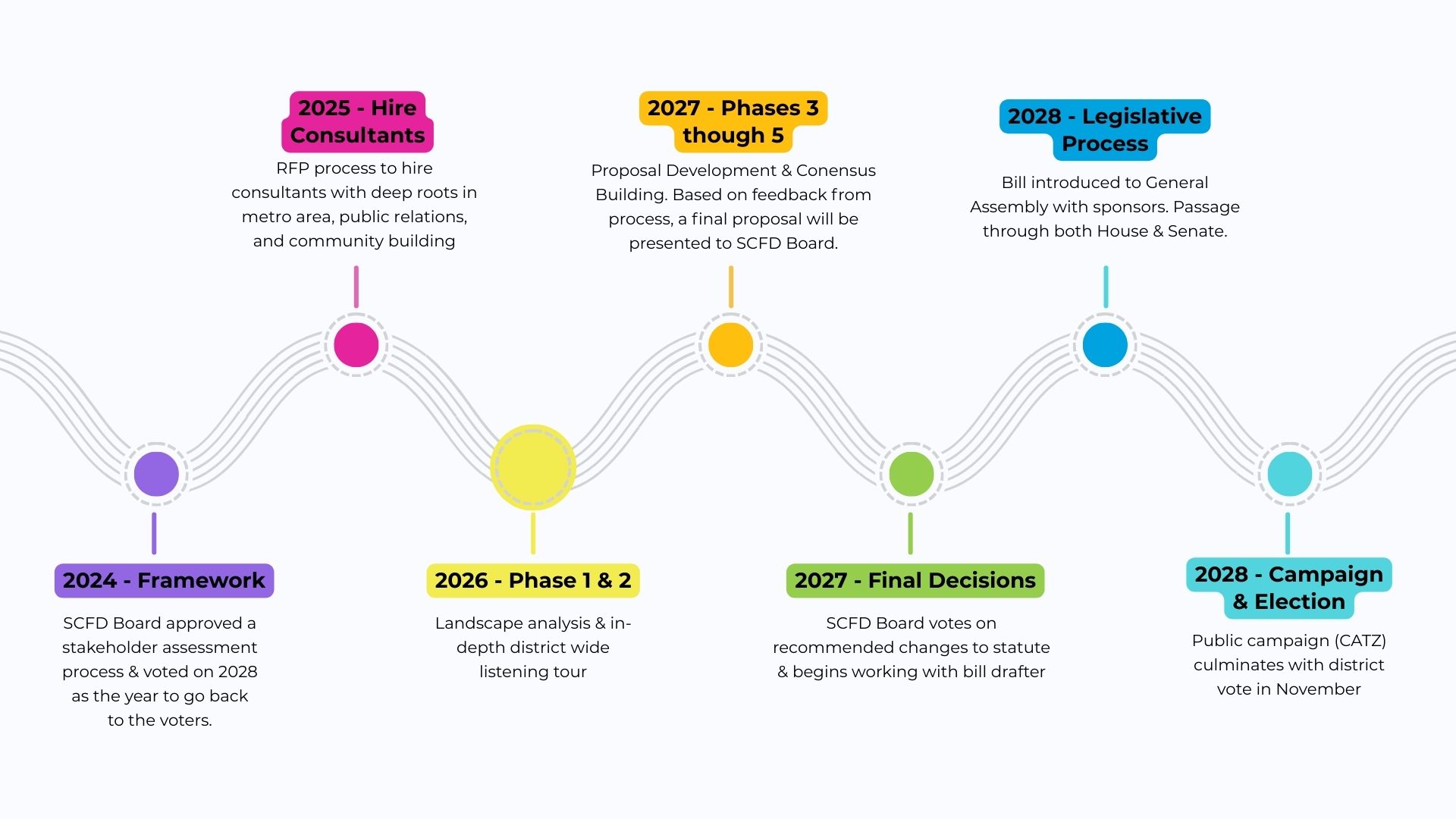
2024 – Process framework approved
2025 – Hired consultants (GBSM)
2026 – Phases 1 & 2: Landscape Analysis and District-Wide Listening Tour
2027 – Phases 3 through 5: Proposal Development, Consensus-Building, Board Presentation
2027 – Final Decisions: SCFD Board votes to approve changes to statute
2028 – Legislative Process: Bill introduced to General Assembly with updated statute
2028 – Campaign & Election: Public campaign run by CATZ culminates with district vote in November
Phase 1 Early Learnings
Learn more details about the reauthorization process, how you can shape it, and some early insights from the first few months of Phase 1 engagement efforts by watching this informational webinar on the Road to Reauthorization hosted by SCFD staff and the GBSM project team.
Watch the webinar below:
View the slide deck (PDF) used in the webinar.
The Road Map
Want to learn even more about the Stakeholder Engagement Process? Check out the handy dandy Road to Reauthorization Overview sheet (PDF) below with all the info you need to know in one place. It has everything from at-a-glance information about process activities over the next two years, an overview of the journey to the district as it stands today, and impacts and challenges of the SCFD funding model that we hope to address through this process.
Stakeholder Engagement Process Updates:
SCFD’s Executive Director, Andrea Albo, provides brief updates on the stakeholder engagement process in her monthly newsletter segment, “In Focus with Andrea”. To receive these updates directly to your inbox, subscribe to SCFD’s mailing list here. You can review previous updates below:
- September 2026 Newsletter
- August 2026 Newsletter
- July 2026 Newsletter
- June 2026 Newsletter
- May 2026 Newsletter
- April 2026 Newsletter
- March 2026 Newsletter
- February 2026 Newsletter – Meet the GBSM Project Team!
- January 2026 Newsletter
- December 2025 Newsletter
- SCFD Selects GBSM as Partner in Stakeholder Engagement Process Ahead of 2028 Reauthorization
Frequently Asked Questions
Below are answers to a few frequently asked questions we’ve heard so far throughout the Stakeholder Engagement Process. We will update this list as we continue through the process on our Road to Reauthorization.
SCFD is a 30+ year old cultural tax approved by voters in Adams, Arapahoe, Boulder, Broomfield, Denver, Douglas and Jefferson counties that is up for renewal in 2028. Over the next two years, SCFD and its consultant, GBSM, will facilitate a five-phase Stakeholder Engagement Process to build proposed changes to the funding model and structure to position the region for the next era of SCFD. The proposal will then need to be approved by the SCFD Board and then the Colorado General Assembly before making its way to the November 2028 ballot in the seven counties SCFD operates in. You can read the framework for this process here.
After a robust research and selection process, SCFD selected a team of experts led by GBSM as our partner to work objectively and analytically through Phases 1-5 of our Stakeholder Engagement Process. GBSM is a Colorado-based consulting firm that, over the last 40 years, has used authentic engagement, creative thinking, sound strategy and consensus and coalition building to address some of the Rocky Mountain West’s most complex issues. The GBSM project team has a vast array of experience in public engagement, strategic communications, consensus-building, and culturally relevant outreach, paired with extensive knowledge of Denver’s cultural landscape. Core project team members include Andy Mountain, Moe Gram, Neil Walia, Alana Plaus, JC Futrell, Virginia Garcia Pivik, John Karner, and Kayleigh Cornell. Meet the team here.
In August 2024, the SCFD board of directors adopted a proposed stakeholder process to prepare the SCFD for a 2028 reauthorization. It was based on interviews with a diverse group of funded partners representing a broad array of district tiers, disciplines and communities. It outlines the following process:
- Phase 1: Research and Landscape Assessment (Nov 2025 – Jun 2026)
- Phase 2: District-Wide Listening Tour (Apr 2026 – September 2026)
- Phase 3: Initial Proposal Development (July 2026 – December 2026)
- Phase 4: Proposal Refinement and Stakeholder Consensus Building (October 2026 – June 2027)
- Phase 5: Final Proposal and Board Action (April 2026 – December 2027)
As of March 2026, GBSM is conducting financial analysis of the current funding model and informational interviews with community leaders across all Tiers as part of Phase 1, Research and Landscape Analysis.
Early learnings about SCFD’s impact on the community as well as challenges with the model can be found in this Road to Reauthorization Project Overview Sheet from Phase 1 (PDF).
SCFD and its funded partners have ensured remarkable impact on the community, enabling transformational experiences and unparalleled opportunities and access to arts, culture, and science. In 2024, SCFD made a meaningful and powerful impact by providing free experiences, educational experiences for children, and serving more than 15 million people.
On the other hand, SCFD’s funding model is complex, and hasn’t changed very much since funds were first distributed nearly 40 years ago. We anecdotally know there are challenges with areas such as tier compression, tier mobility, and differences in county cultural council grantmaking.
SCFD has been passed with great public support during the last three reauthorizations:
- 1994 – Passed at 57% of the vote
- 2004 – Passed at 65.7% of the vote
- 2016 – Passed at 63% of the vote
While voter approval for the 2028 reauthorization is our end goal, SCFD has committed to centering inclusivity, transparency, and the recognition that society and the arts have both changed profoundly over time. Our path to achieving a successful reauthorization will address that.
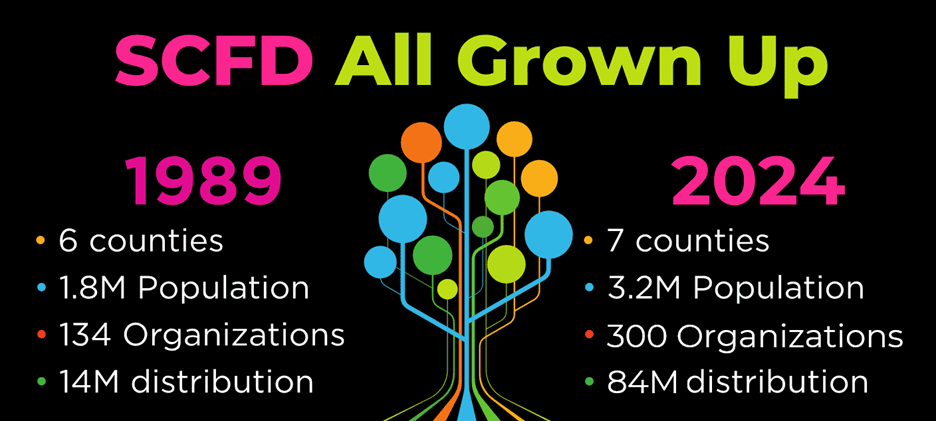
Since the SCFD was formed, the population of the district has nearly doubled, the number of organizations funded has more-than doubled with the number of Tier I organizations growing by 20%, Tier IIs by 386% and Tier IIIs by 118%, and the amount of funding distributed has increased by more than five times.
Since the district was formed in the late 1980’s, the funding model has not undergone significant changes. It has always been a three-tiered model providing mostly general operating support to eligible nonprofits. Some of the bigger changes from past reauthorization efforts include the elevation of the Denver Center for the Performing Arts from Tier II to Tier I in 2004; 2004’s addition of Broomfield County as a member of SCFD when it was formed as a county, and the shift in formula funding during the 2016 reauthorization.
You can view the table in the Project Overview Sheet (PDF) to learn more about how funding distributions per tier have changed over time.
The statute is complex and must be analyzed as a complete model. We are looking at all parts of this model, and we want to hear from you about what’s working and what isn’t. Here are some challenges we’ve heard about so far (PDF). We want all ideation included in our analysis over the course of the stakeholder engagement process so that together, we can build a stronger SCFD.
As SCFD continues its efforts towards a successful reauthorization of the district, the Board of Directors recently reviewed and approved a performance scorecard which staff will use to track progress on strategic initiatives supporting the road to reauthorization. Below you can find a graphic that summarizes this scorecard and key focus areas including internal organizational health, board business, and external organizational health. We’ll continue to share updates as we continue this strategic work. 
- Stay in the loop – bookmark this webpage and sign up for our newsletter for ongoing updates about the Stakeholder Engagement Process.
- Spread the word – share updates with your network! Help us make sure that our cultural community is informed and engaged in the process.
- Share your feedback – Keep your eye out for upcoming listening sessions and survey opportunities! Your feedback is integral in ensuring our collective impact on this new model, and we want to hear all perspectives. When an opportunity arises, please participate and encourage others in your network as well.